Detail
The university’s anniversary brought the university community together

Team AlumniService
13/11/2026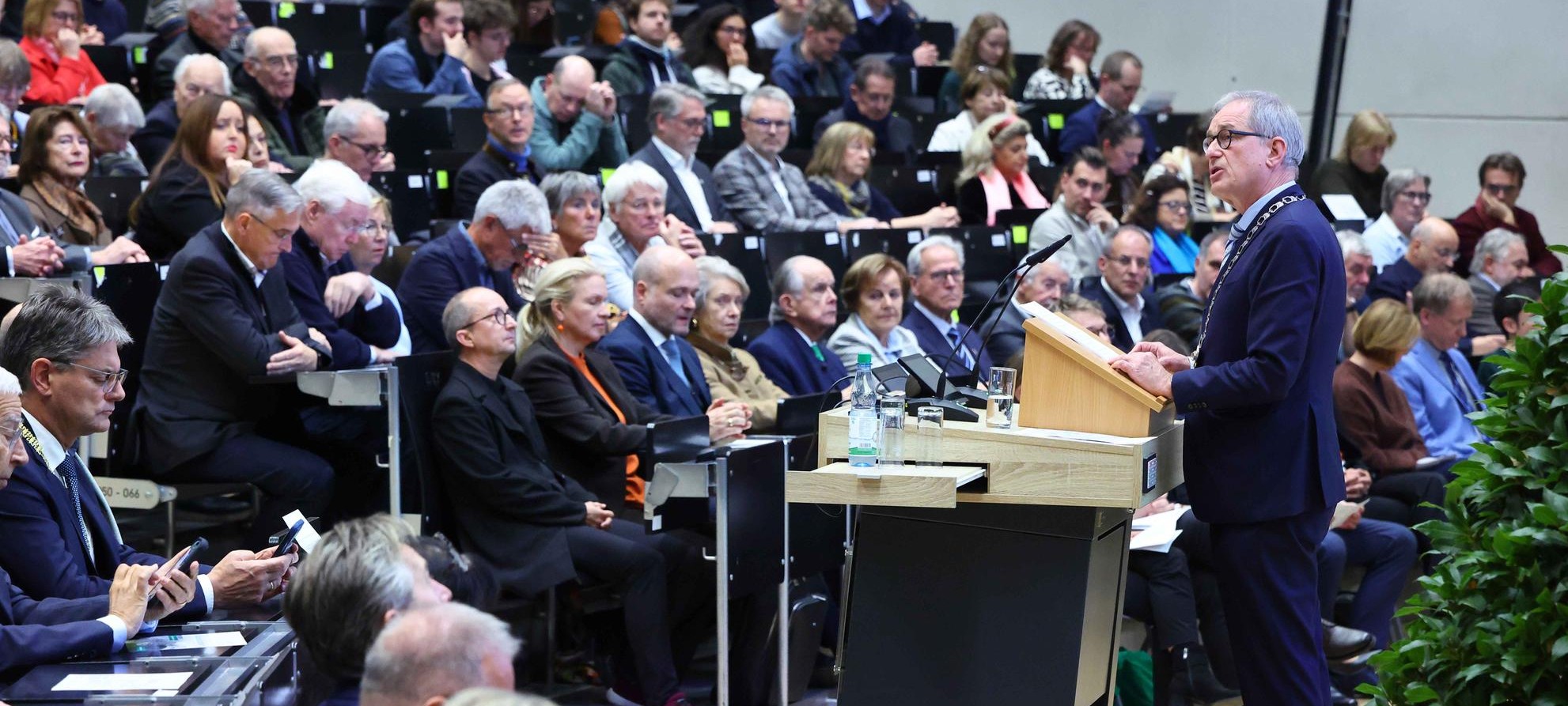
The Annual Academic Ceremony focused on future-oriented topics such as artificial intelligence, sustainability, internationalisation and responsible science
The University of Bayreuth held its Annual Academic Ceremony with a focus on the major questions of our time. The 51st Dies Academicus centred on challenges that concern academia, society, politics and business in equal measure: the responsible use of artificial intelligence, adherence to planetary boundaries, sustainable development and the role of universities in a rapidly changing world. More than 700 guests from academia, politics, business and society gathered for the event in the university’s Audimax.
In a video message, Bavaria’s Minister for Science, Markus Blume, praised the University of Bayreuth’s development as one of Germany’s most dynamic university centres. He particularly highlighted the rising student numbers, the university’s high appeal to prospective students and its distinctive research profile. “The University of Bayreuth is growing and inspiring: more first-year students, top ratings from students and a research profile ranging from AI to sustainability and African studies. What’s more, the University of Bayreuth is the start-up champion, ranking first in the Stifterverband’s Start-up Radar. Anyone who wants to know how the future is shaped will find one of the most innovative university centres in the country here. With the amendment to our Higher Education Innovation Act, we are providing further impetus. The guiding principle for our universities is: less bureaucracy, more agility.”
Following the memorial service, University President Prof. Dr Dr h.c. Stefan Leible looked back on the developments and achievements of the past year. At the same time, he addressed the challenging conditions under which academia and universities operate today. International conflicts, geopolitical tensions, increasing export controls and social polarisation have made research and cross-border exchange more difficult: “It is precisely at a time of economic and social uncertainty that the importance of strong universities becomes apparent. Over the past year, the University of Bayreuth has consistently continued on its path as an internationally networked, research-intensive and innovative university, thereby further enhancing its significance for science, society and the entire region.”
Universities are therefore called upon more than ever to defend academic freedom, provide guidance and strengthen fact-based social dialogue. “Democracy, social cohesion and the respectful exchange of differing viewpoints cannot be taken for granted. As a university, we stand for academic freedom, diversity and democratic participation – and we will resolutely defend these values even in times of increasing polarisation,” said the Vice-Chancellor in his speech.
The highlight of the event was the keynote address by Dirk Steffens, a science journalist, documentary filmmaker, bestselling author and holder of an honorary doctorate from the University of Bayreuth. In his talk, entitled ‘Planetary Boundaries – What Nature Teaches Us for the Future’, he explained the Earth’s ecological limits and highlighted the consequences these have for politics, the economy and society. Scientific findings, he argued, form the central basis for successfully tackling global challenges and developing sustainable solutions.
Speaking to an audience of more than 700 people, Steffens also advocated for a scientifically grounded optimism. Drawing on his latest book, *Hopelessly Optimistic*, he made it clear that humanity already possesses numerous solutions to many of the pressing problems. The key, he said, is to implement these solutions consistently and raise their profile. Science must not limit itself to producing findings, but must also communicate them in an accessible way. Research findings are particularly effective when they reach people and shape public debate. With a twinkle in his eye, Steffens described his own role as an attempt to “make research a bit sexy”. Science is best communicated through stories and can thereby provide guidance, hope and confidence.
During his visit, Dirk Steffens also signed the University’s Golden Book. His entry read: “There is no sensible alternative to optimism.”
The University as a driving force for the future
The Annual Academic Ceremony thus offered not only an opportunity to look back on a successful academic year. It also served as a forum for exploring how science, innovation, artificial intelligence and social responsibility can collectively contribute to actively shaping the future. It became clear that the University of Bayreuth sees its role not only as a centre of excellence in research and teaching, but also as a catalyst for social debate, democratic cohesion, sustainable development and regional innovation.
View the photo gallery:
Anniversary 2026: Looking back together, looking ahead together
Please find the full press release covering all topics here.
© UBT